English
 العربية
 Français
 Русский
 Español
 Português
 Deutsch
 Italiano
 日本語
日本語
 한국어
한국어
 हिन्दी

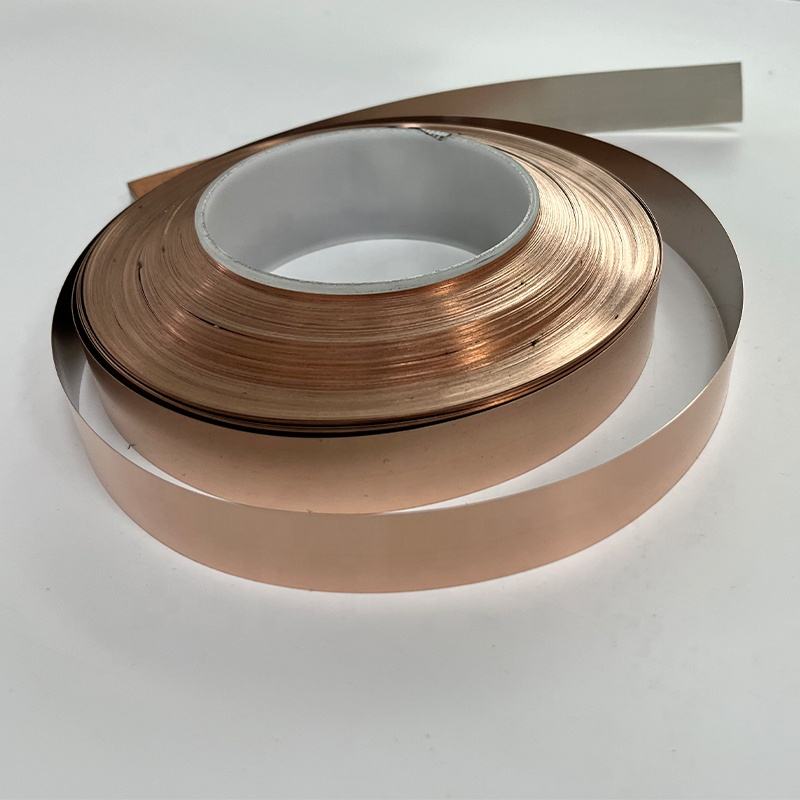
Copper-nickel clad strip is critical for power battery connectors, directly affecting current-carrying capacity, weld reliability, and long-term life. Before purchasing, verify these 5 essential parameters.
1. Single-Side vs. Double-Side Cladding Type
- Single-side nickel (copper + nickel on one side): Used for connecting to aluminum tabs to prevent galvanic corrosion between copper and aluminum.
- Double-side nickel (copper + nickel on both sides): Used for connecting to copper tabs, ensuring symmetric weldability and corrosion resistance.
Choosing the wrong type leads to weld failure or premature battery failure.
2. Bond Strength (Peel Force)
- Critical requirement: ≥10 N/mm (recommended, may vary by process)
- Test method: According to GB/T 5270 or equivalent, fix the clad strip and peel the nickel layer at 90° or 180°, recording the average peel force per unit width.
- Risk: Insufficient bond strength causes edge separation (splitting) during stamping, severely reducing weld yield.
3. Thickness Tolerance & Uniformity
- Overall thickness tolerance: Typically within ±0.005 mm (depending on specification)
- Single nickel layer deviation: Should be controlled within ±10%
- Effects:
- Too thin nickel → weld burn-through, reduced corrosion resistance
- Too thick nickel → increased resistance, excessive heat generation
- Non-uniform thickness → uneven spot welding current, cold welds
4. Hardness & Springback (Half-Hard / Soft Temper)
- Soft (annealed) : Good formability, stable tab contact pressure, but lower strength.
- Half-hard : Suitable for high-precision stamping and elastic contact structures, with controlled springback.
- Recommendation : Choose half-hard for high-speed automated lines; choose soft for complex bending applications. Excessive hardness variation leads to fluctuating contact resistance.
5. Surface Roughness & Cleanliness
- Surface roughness: Ra ≤ 0.2 μm (recommended). Higher roughness reduces ultrasonic welding energy transfer efficiency.
- Cleanliness: Free from oil, oxides, and residual particles.
- Impact:
- Ultrasonic welding: Contamination causes horn slipping and reduced weld strength.
- Laser welding: Oil residue causes spatter and porosity.
- Inspection method : Dyne pen test for surface energy, or use a cleanliness tester for random sampling.
Summary
Copper-nickel clad strip is not a simple metal laminate. Cladding type, bond strength, thickness accuracy, hardness state, and surface quality are all indispensable. Before bulk purchasing, request sample validation and obtain the factory inspection report (including peel force curve and thickness profile).