English
 العربية
 Français
 Русский
 Español
 Português
 Deutsch
 Italiano
 日本語
日本語
 한국어
한국어
 हिन्दी

Introduction: Why Material Selection Matters
In EV battery systems, tabs and busbars are critical for current transmission and cell interconnection. Material selection directly impacts:
- Electrical resistance
- Heat generation
- Safety and reliability
- Lifecycle cost
With the rise of high-voltage platforms (800V) and fast charging (≥2C), traditional materials are no longer sufficient. Cu-Ni clad strip is rapidly becoming the industry standard.
1. Performance Comparison of Three Materials
| Property | Cu-Ni Clad | Pure Nickel | Nickel-Plated Copper |
|---|---|---|---|
| Conductivity | 65–75% IACS | 20–25% IACS | 55–60% (unstable) |
| Resistance | Low | High | Medium (degrades) |
| Weldability | Excellent | Good | Poor |
| Corrosion Resistance | Excellent | Good | Poor |
| Cost | Low | High | Medium (high lifecycle cost) |
| Service Life | 8–10 years | 3–5 years | 2–4 years |
2. Limitations of Pure Nickel Strip
- Low conductivity → significant energy loss
- High heat generation → safety risks
- Reduced EV range (10–15%)
- High raw material cost
Pure nickel is no longer suitable for high-current EV applications.
3. Why Nickel-Plated Copper Is Unreliable
Key Issues:
- Coating peeling due to physical bonding
- Welding defects (cold weld / false weld)
- Thermal expansion mismatch
- Rapid degradation under high temperature
Despite a lower upfront cost, the lifecycle cost is high.
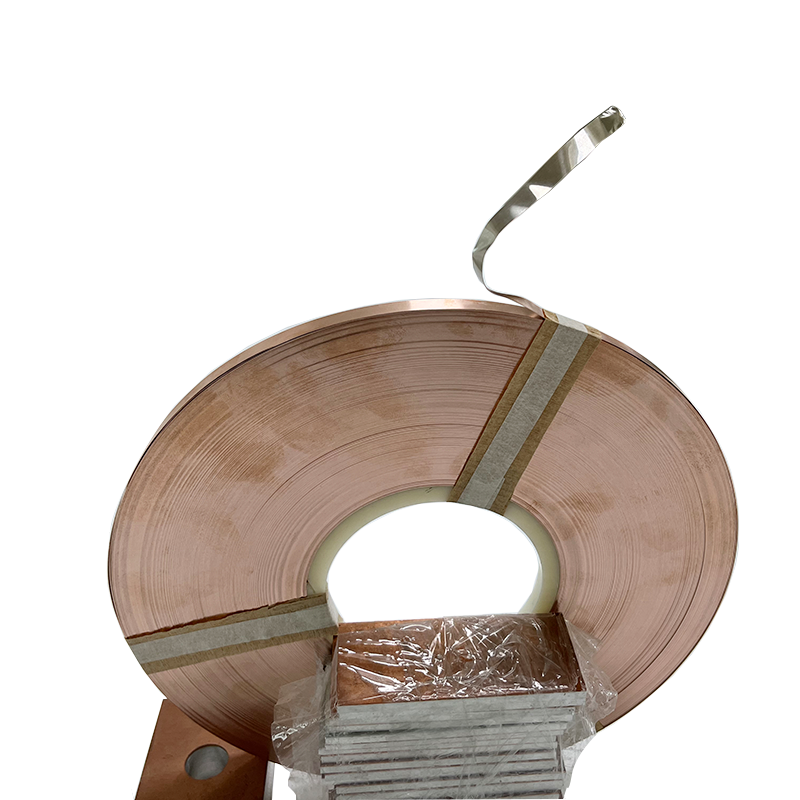
4. Advantages of Cu-Ni Clad Strip
4.1 Metallurgical Bonding (No Delamination)
- Atomic-level bonding
- High structural integrity
- No peeling risk
4.2 High Conductivity, Low Resistance
- Near-copper performance
- 10% energy loss reduction
4.3 Excellent Weldability
- Compatible with ultrasonic, resistance, and laser welding
- Stable, defect-free joints
4.4 Electrochemical Compatibility
Nickel layer acts as a barrier between copper and aluminum, preventing galvanic corrosion.
4.5 Long Service Life
- 8–10 years
- Resistant to electrolytes and harsh environments
4.6 Cost Efficiency
- 30%+ cheaper than pure nickel
- No rework or replacement cost
5. Typical Applications
- Prismatic battery modules
- Pouch cell tab connections
- Cylindrical cell busbars (18650, 21700, 4680)
6. Material Selection Guide
| Scenario | Recommended Material |
|---|---|
| Low current applications | Pure nickel |
| Light EV / power tools | Thin Cu-Ni clad |
| EV traction batteries | Standard Cu-Ni clad |
| Fast charging systems | Thick Cu-core clad |
Conclusion
Cu-Ni clad strip outperforms traditional materials in:
- Conductivity
- Cost
- Reliability
- Lifecycle performance
It is the most balanced and future-proof solution for EV battery interconnection systems.